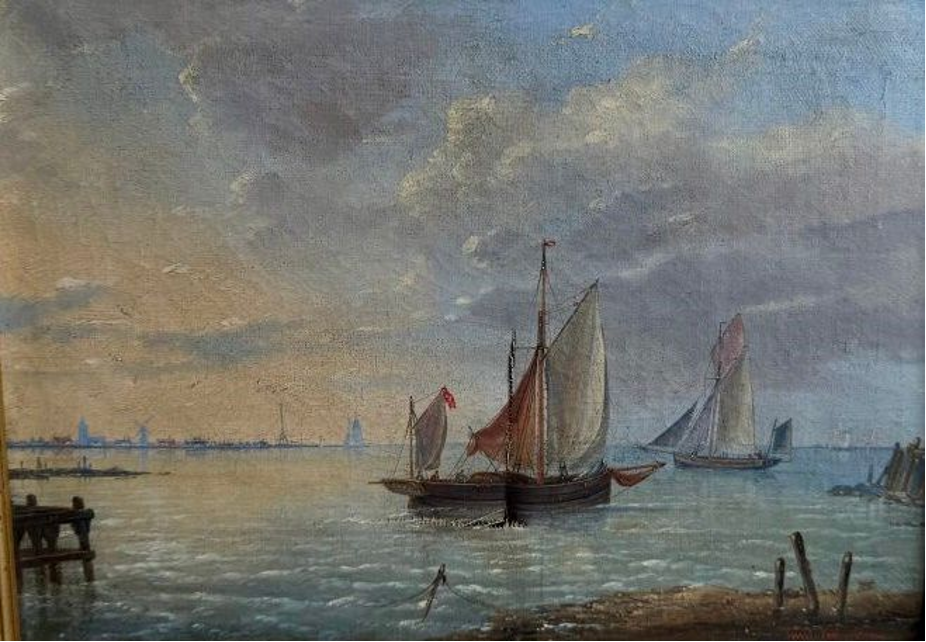
Medium: Oil on panel
Dimensions: 25 × 35 cm - Original canvas
Signature: Signed lower right ‘Louis Verboeckhoven’
Period of execution: circa 1875
Price: ¥ 16,000
Verboeckhoven’s marine landscapes occupy a distinctive position between French Romantic chromatic brilliance—evoking classical pastoral tranquillity—and the poetic patriotism characteristic of British maritime painting as pioneered by J.M.W. Turner. This work depicts a serene harbour scene in an estuary, likely inspired by the Belgian or northern French coasts. The luminous white sails set against a clouded sky, with delicate reflections shimmering across water, establish striking visual parallels with Paul Jean Clays’s Ships Lying near Dordrecht (National Gallery, London).
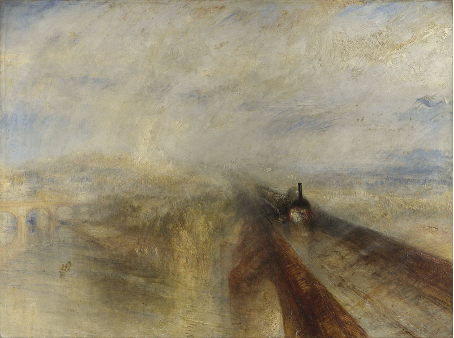
Both Clays and Verboeckhoven trace their stylistic lineage to French Romanticism, particularly Émile-Jean-Horace Vernet and Claude-Joseph Vernet, preeminent landscape painters of the late eighteenth century. Clays studied marine painting directly under Horace Vernet, absorbing principles that Verboeckhoven likewise assimilated through sustained engagement with this tradition. Verboeckhoven's deployment of cobalt blue skies and lighter ultramarine tonalities for sea waves derives from Claude-Joseph Vernet's topographical practice. This nuanced chromatic brilliance distinguishes his work from Clay's more restrained palette. Verboeckhoven seeks classical temperament inflected by personal sensibility—reinscribing scenes with both pristine clarity and sublime elevation. This approach also differentiates him from Turner, whose fervent impasto technique prioritised internal sensation at the expense of naturalistic fidelity. Verboeckhoven instead employs restrained academic methods—alternating blending and feathering through successive layers—to achieve refined realism that delivers visual immediacy while maintaining compositional equilibrium and atmospheric poetry.
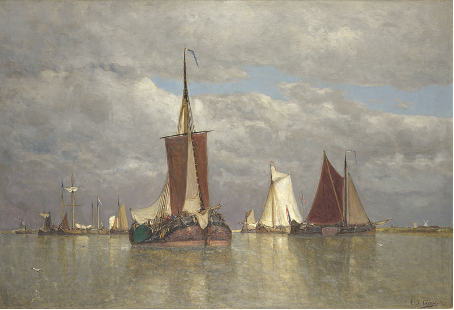
(fig. 1) Paul Jean Clays, Ships lying near Dordrecht, 1870, The National Gallery, London
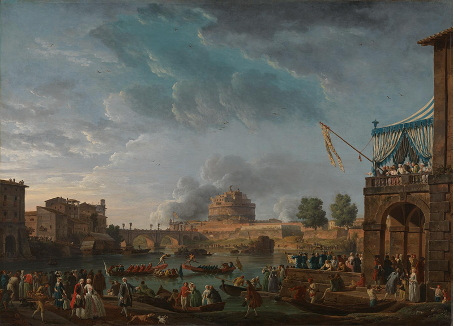
(fig.2)Claude-Joseph Vernet, A Sporting Contest on the Tiber, 1750, The National Gallery London
Louis Verboeckhoven, whose full name was Charles-Louis Verboeckhoven (1802–1889), was a Belgian painter known primarily for his marine and fishing scene paintings in the Romantic style.
Born in Comines-Warneton, Belgium, in 1802, Louis Verboeckhoven was part of an artistic family. He received his artistic training from his father, Barthélemy Verboeckhoven, a sculptor, and his older brother, Eugène Verboeckhoven, a renowned animal painter. He began his career as a landscape and animal painter, but after the family moved to Ghent in 1815, he developed an interest in marine painting, influenced by Frans Balthasar Solvyns. In 1827, he settled in Brussels, where he exhibited his marine works, which quickly gained popularity. Louis devoted himself to Belgium’s independence cause since 1830, where he served as a sergeant. He returned to being an artist when Belgium claimed independence .
Verboeckhoven is most famous for his dramatic and atmospheric seascapes, often depicting fishing vessels or large two-masted brigs in both calm and tempestuous seas. His work is a notable example of the 19th-century Romantic style, though his later works after 1842 adopted a more realistic approach with brighter colours. He was a member of the Salon de Paris and the Academy of Amsterdam. He had a son, also named Louis Verboeckhoven (d. 1884), who became a painter of landscapes and still life. To distinguish them, the father is often referred to as Louis I Verboeckhoven or Charles-Louis Verboeckhoven. His works are housed in museums in Antwerp, Brussels, and Liège, among others.



 CN
CN